Autism Skill Assessment and Programming Tools
Before deciding what to teach, we need to understand the learner.
AAPT is a strength-based framework for understanding how an autistic child or individual learns and for translating that understanding into meaningful, individualized goals and supports.
At the heart of AAPT is a simple principle:
Before deciding what to teach, we need to understand the learner.
Rather than looking only at whether a skill is present or absent, AAPT considers how the child uses that ability across people, places, routines and environments, and with different levels of support. This helps us recognize existing strengths, notice emerging abilities and consider what may provide meaningful next steps.
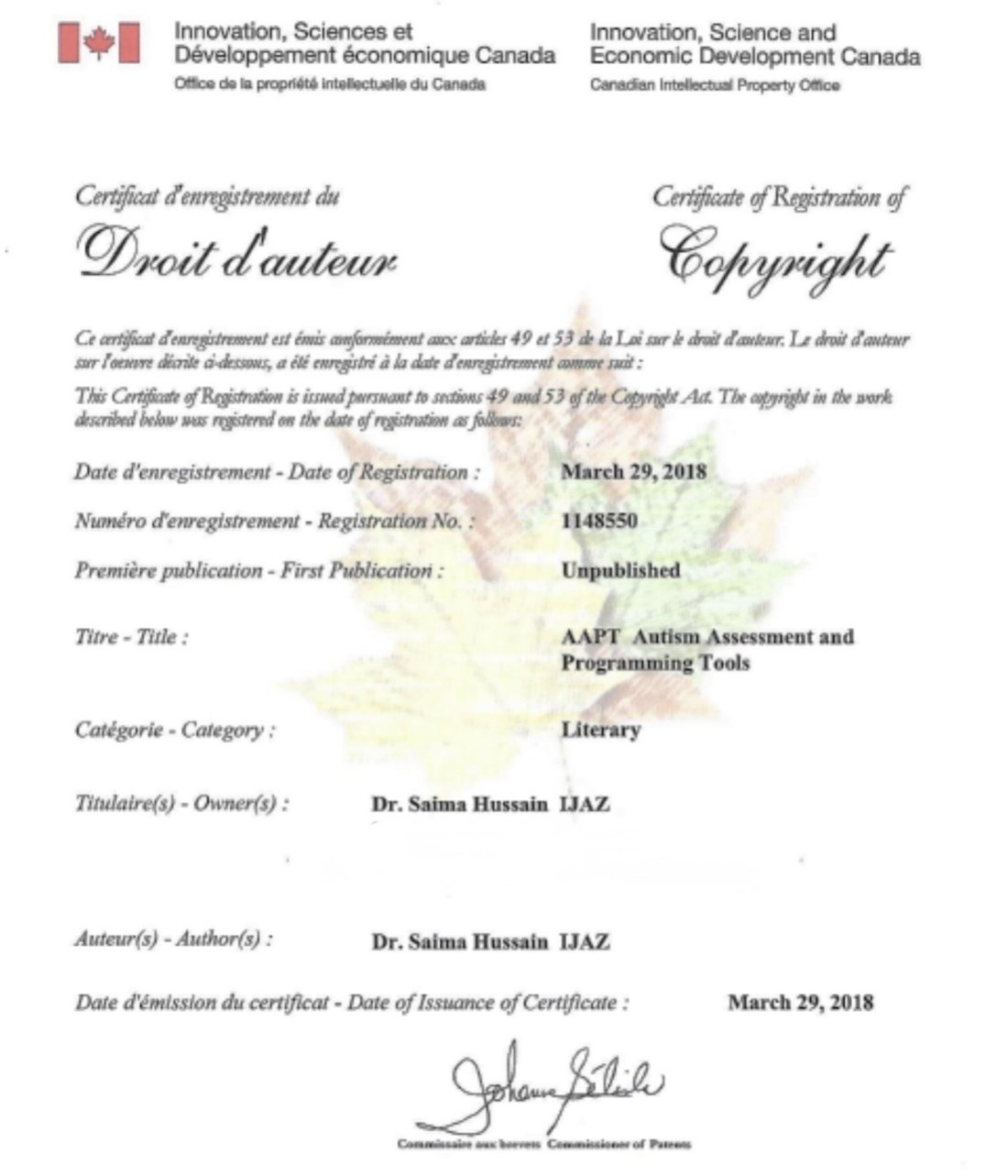
AAPT was registered with Innovation, Science and Economic Development Canada (ISED) in 2018. It provides a structured framework for assessment, programming and progress tracking while allowing the individual child's abilities, interests, sensory experiences, communication and relationships to influence where and how learning begins.
From Family Hopes to Individual Starting Points
Families often come to intervention with important hopes for their child: to communicate, play, interact with others, learn, participate more fully in everyday life, become toilet trained, eat more independently or manage personal-care routines.
These are meaningful goals.
Parents should not be expected to know all the smaller developmental steps through which those goals might be approached. Part of the consultant's role is to bring together the family's knowledge and priorities with careful observation of the individual child and help identify appropriate starting points.
A child who is not yet speaking, for example, may already be communicating by looking toward something, leading another person, moving someone's hand, using gestures or pictures, or showing clear acceptance and refusal. AAPT asks us to recognize what is already present and build from there rather than beginning only with the eventual goal of spoken language. This progression is already reflected within the Communication domain.
The same principle applies across play, social interaction, learning, self-care and other areas of development. The family's goals help us understand where they would like to go. Understanding the child helps us decide how we might get there.
Assessment and goals are only useful when they help us decide what to do next, and where it makes sense to begin.
Understanding the Learner
AAPT begins with the child rather than with a predetermined sequence of objectives.
Before selecting teaching goals, we consider:
- existing abilities and emerging skills;
- interests and what is already meaningful to the child;
- sensory preferences and sensitivities;
- communication and how the child currently expresses needs, choices and intentions;
- attention, engagement and readiness for participation;
- relationships with familiar people;
- visual, motor, imitation and other possible routes into learning;
- and how abilities change across people, environments and everyday routines.
This broader picture helps us distinguish between something the child cannot yet do, something they can do under particular conditions or with support, and something they understand well enough to use independently and meaningfully.
The question is therefore not simply: "What can't this child do yet?" It is also:
"What is this child already showing us, and what might that tell us about where to begin?"
The 26 AAPT Domains
AAPT organizes observation and assessment across 26 developmental and functional domains. Together they include areas of attention and engagement, visual learning, communication, play, imitation, language, motor development, self-care, social participation, classroom learning, generalization, literacy and functional academic skills.
The domains are interconnected. A child's communication may be affected by sensory experiences. Visual abilities may provide another route into language or learning. Motor imitation may create opportunities for shared engagement. A familiar interest may make participation with another person possible.
For this reason:
The domains give us places to observe. They are not a predetermined sequence to follow.
Assessment: Looking Beyond "Can Do / Cannot Do"
AAPT assessment brings together information from people who know the child in different contexts, including parents and caregivers and, where involved, teachers, educational assistants, therapists, interventionists and other support professionals.
Assessment considers not only whether a child demonstrates an ability, but also how, where, when and with whom it occurs.
This may include considering consistency, familiarity of people and environments, sensory influences, level and type of support, participation within familiar routines and whether the ability begins to appear naturally in other situations.
This helps us recognize an important difference between:
From Assessment to Programming
Assessment is only useful when it helps us decide what to do next.
Families may identify several broad areas that matter to them. Assessment may also reveal strengths or developmental areas that deserve closer attention.
An individualized AAPT plan may therefore include approximately 5 to 10 priority domains representing meaningful areas within the child's overall program.
But identifying a domain as a priority does not mean creating multiple new demands for the child or attempting to teach everything within that domain at once.
A Priority Domain Is Not a List of Tasks
Within each priority domain, we first ask: Where is this child now?
We look for the abilities already present, what may be beginning to emerge and the conditions under which the child is most comfortable, engaged and able to participate.
- A broad family goal such as "I want my child to communicate" may begin with recognizing and strengthening the ways the child is already attempting to communicate.
- "I want my child to play with others" may begin with discovering what the child already enjoys and learning how another person can gradually become part of that experience.
- "I want my child to learn" may lead us to explore whether visual information, imitation, movement, familiar routines or particular interests provide stronger routes into learning.
- "I want my child to be toilet trained" may begin by understanding which parts of the routine the child already recognizes and tolerates, how they communicate around toileting, and where predictability, sensory comfort or support may be needed. AAPT's Toileting domain similarly breaks the routine into observable components rather than treating toileting as a single all-or-nothing skill.
The broader goal remains important. The starting point becomes individualized.
Building Carefully, Not Covering the Framework
Assessment may reveal many promising abilities and many possible next steps. They do not all need to become immediate objectives.
Areas to explore are not automatically areas to teach.
An emerging ability is not automatically an immediate expectation.
Within the broader priority domains, a smaller number of meaningful objectives can be actively developed at any one time. Other areas may be observed, supported naturally within everyday routines, or allowed more time to emerge.
Sometimes the appropriate next step is not to introduce another objective. It may be to strengthen engagement, make communication more understandable, adapt the environment, develop familiarity and trust, or continue observing what the child is showing us.
The child's interests, sensory and emotional availability, relationships, willingness to participate and response to what we introduce continue to guide the pace.
The aim is not to cover the framework. The aim is to understand the learner and build carefully from what is ready to grow.
Following Learning Across People and Environments
Progress is not simply the completion of objectives.
A child may demonstrate an ability with one person, in one setting or with particular materials before being able to use it elsewhere. AAPT therefore pays particular attention to whether abilities become increasingly available across people, routines, environments and everyday situations.
Families and professionals may see different parts of that development. Bringing those observations together can give us a more complete picture of what is changing and under what conditions learning is becoming meaningful.
Who Is AAPT For?
AAPT can support collaborative planning among parents and caregivers, educators, therapists, interventionists, support workers and multidisciplinary teams.
Professionals can use the framework to support assessment, goal development, documentation and progress monitoring. Families can use it to better understand their child's abilities, priorities and ways of learning and to participate more confidently in decisions about supports and programming.
AAPT can also extend beyond early childhood where its developmental and functional domains remain useful for individualized daily-life goals and support planning.
Five Sample Domains
See how the domains are laid out by looking at five sample sheets.
- AAttention & Cooperation →
- BVisual Performance →
- CSelf Identity & Likes →
- DPlay & Leisure Skills →
- ECommunication Skills →
See the Bigger Picture
Summary of the 26 Domains →
What does AAPT look at?
Domains Form →
Where might we look more closely?
Domains & Skills Tracking Sheet →
What is changing over time?